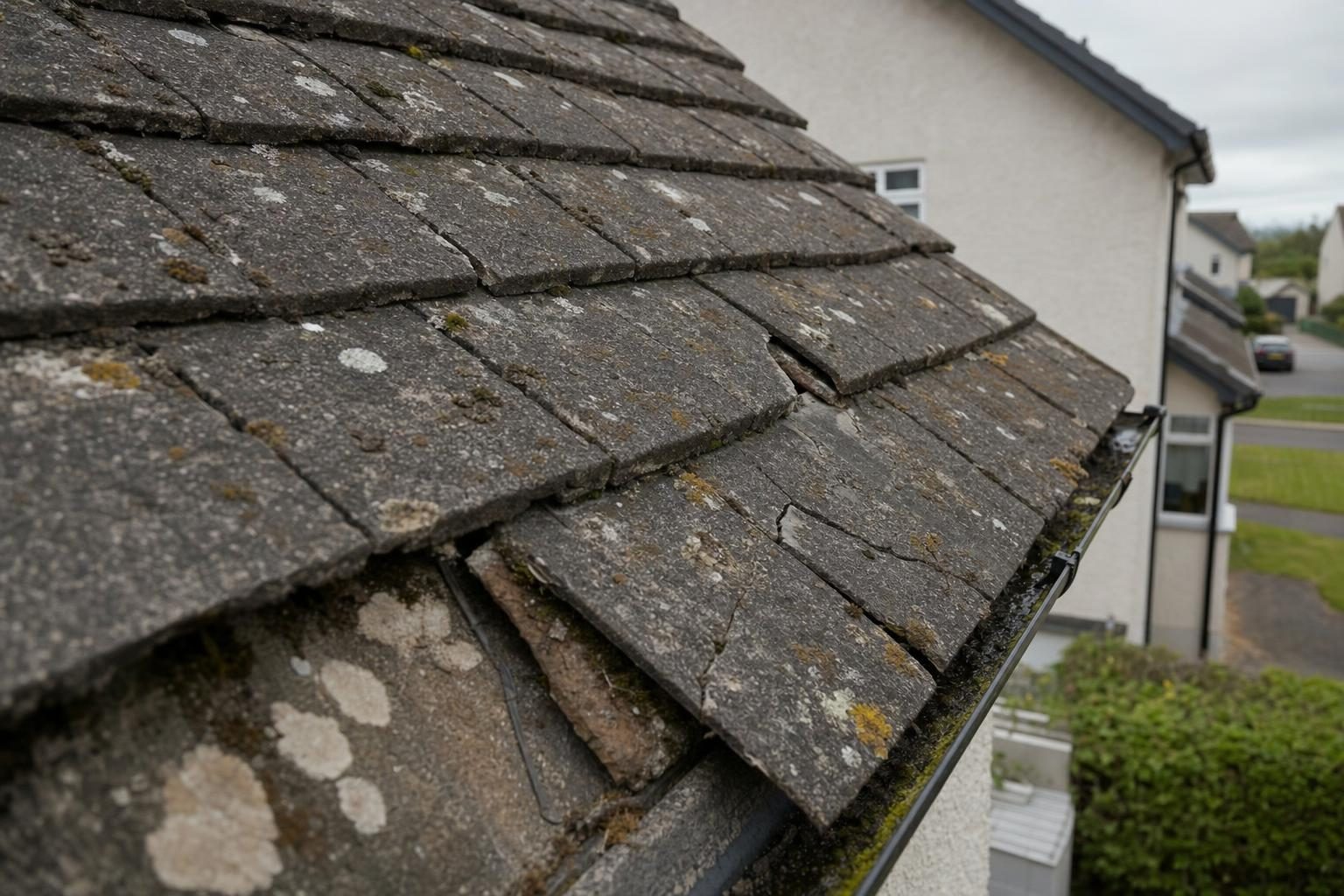
Close-up of weathered roof tiles with visible cracking and moss growth on an Irish home
Roofing Guide

Signs You Need a New Roof in Ireland

Not sure if your roof needs a repair or a full replacement? Here is what to look for — and what it means.

Call for a Free Inspection

Most Irish roofs give you clear warning signs before they fail completely. The problem is knowing what you are looking at. A few slipped slates is a repair job. Widespread cracking, recurring leaks and soft or rotten timbers underneath are signs the whole roof needs to come off. This guide walks you through the most common warning signs, what causes them and what a roofer will do about it.

If you are already seeing water inside your home, do not wait. Get in touch with us for a fast, free inspection — we cover Limerick city and the surrounding areas including Castletroy, Dooradoyle, Raheen, Corbally, Caherdavin, Mungret and Patrickswell.

What to Look For

7 Warning Signs Your Roof May Need Replacing

Slipped, Cracked or Missing Slates and Tiles

One or two displaced slates after a storm is normal wear. If you are seeing widespread breakage, or the same slates keep moving, the nails or clips holding them have corroded through — a sign the whole roof covering is at the end of its life.

Daylight Visible in the Loft

Go into your loft on a bright day and turn off the light. Any pinpricks of daylight mean gaps in the covering. Small gaps let in wind-driven rain; large gaps mean the structure below has been exposed for some time.

Damp or Wet Insulation in the Loft

Saturated insulation loses most of its effectiveness and is very slow to dry out. If the timbers beneath it feel soft when you press them, rot has set in. Replacing the insulation alone is not enough — the source of the water needs to be found and fixed first.

Water Stains on Ceilings or Walls

Brown staining or peeling paint on an upstairs ceiling is almost always a roof problem. The tricky part is that the entry point on the roof is often not directly above the stain — water travels along rafters before dripping. Tracing the true source requires a proper inspection from above.

Failing or Cracked Flashing

Lead or mortar flashing around chimneys, skylights and valleys is one of the most common leak points on an Irish roof. Cracked mortar haunching or lifted lead is often repairable, but if it has been left long enough to saturate the underlying timber, a wider repair or replacement is needed. Our chimney repairs in Limerick deal with this regularly.

Heavy Moss or Algae Growth

Moss holds moisture against the surface of slates and tiles, accelerating frost damage over winter. A light dusting can be treated. Thick established growth — especially if slates beneath it are already pitting or laminating — is a sign the covering has been compromised for years.

Damaged Fascia or Persistent Gutter Problems

Rotting fascia boards and gutters that constantly overflow or pull away from the wall are often the result of water backing up under the lowest course of tiles. Left unchecked, this saturates the roof deck and the wall below. If your gutters are part of the problem, our gutter repairs service in Limerick can sort that at the same time.

Making the Decision

Repair or Full Replacement — How to Tell the Difference

This is the question every homeowner wants answered quickly. The honest answer is: it depends on how localised the damage is, the age of the roof and what is happening underneath the covering.

Repair is usually the right call when: the damage is to one specific area, the rest of the roof is sound, the timbers are dry and solid, and the overall covering is well within its expected lifespan. A few slipped slates after a storm, a single failed flashing, or a cracked valley can all be fixed without disturbing the rest of the roof. This is the bulk of our roof repair work across Limerick.

Replacement makes more sense when: slates or tiles are failing in large numbers across the entire surface, the nails or clips fixing them have corroded through, the underfelt has broken down and is no longer shedding water, the roof deck timber is soft or rotten in multiple places, or repeated repairs to the same roof have become a cycle that never fully resolves the leaking.

Older artificial slates — a product widely fitted on Irish homes from the 1970s through to the 1990s — are a particular case. Many of these products begin to delaminate and shed their surface layer after 30–40 years. Once that process starts across a whole roof, patching individual slates rarely keeps pace with the deterioration.

If you are unsure which category your roof falls into, the most useful thing you can do is get a local roofer to inspect it properly before committing to either option.

Understanding the Cost

What Affects the Cost of a New Roof in Ireland?

We do not publish fixed prices here because roof replacement costs vary significantly depending on your specific situation. What we can tell you is what drives the cost up or down, so you know what to ask about when you get quotes.

Roof size and pitch. A steeper roof requires more scaffolding time, more care on the job and usually more material waste at the hips and valleys. A large shallow-pitch roof on a bungalow can actually cost less per square metre than a smaller steeply-pitched one on a two-storey.

Material choice. Natural slate is more expensive upfront than concrete or artificial slate but typically outlasts both by decades. The material you choose now affects how many times you replace the roof in your lifetime.

Condition of the timbers underneath. If the battens, rafters or deck need replacing as well, that adds to the cost. Catching deterioration early — before it spreads to the structural timbers — nearly always reduces the overall bill.

Access and scaffolding. A detached house with easy access around all four sides costs less to scaffold than a terraced property or a roof with a difficult rear elevation.

Chimneys, skylights and valleys. Each penetration through the roof needs its flashing replaced as part of a re-roof. If you have several, this adds time and materials. For a detailed breakdown of what influences costs, read our guide on how much roof repair costs in Ireland.

Why It Matters

What a Professional Roofer Does That You Cannot Do Yourself

Standing at ground level — even with binoculars — you can spot obvious problems. But a proper inspection goes further than that.

  • Walking the roof surface to check for soft spots in the deck that indicate saturation or rot below
  • Checking every flashing point — chimney, skylights, valleys, abutments — for signs of movement or failure
  • Inspecting the loft space for damp timbers, broken felt and evidence of water tracking
  • Identifying whether the underfelt is intact and still functioning as a secondary barrier
  • Giving you an honest, specific assessment of what needs doing now versus what can wait

If you are in Limerick or the surrounding area and you want a straight answer about the state of your roof, get in touch with us today for a free, no-obligation inspection. We cover all our roofing and repair services from the one team.

Common Questions

Frequently Asked Questions

How do I know if my roof needs replacing or just repairing?

Isolated damage — a handful of slipped slates, a cracked flashing, one blocked valley — is usually repairable. If the roof deck is saturated, if slates or tiles are failing in large numbers, or if the same area keeps leaking after repairs, replacement is almost always the better long-term investment.

What is the lifespan of a typical Irish roof?

A natural slate roof in good condition can last 80–100 years. Concrete interlocking tiles typically last 40–60 years. Older artificial slates (particularly certain fibre-cement products from the 1970s and 80s) often begin to delaminate after 30–40 years. Felt flat roofs have a much shorter lifespan of around 10–20 years depending on the system used.

Can I check my roof myself?

You can look at the roof from the ground with binoculars, and you should check your loft space regularly for daylight, damp insulation or water stains on the timbers. However, walking on a roof without proper equipment is dangerous and can cause further damage. A roofer will carry out a thorough inspection safely.

Does a leaking roof always mean I need a full replacement?

Not always. Many leaks come from failed flashing around a chimney or a single broken slate — both straightforward fixes. The key question is whether the problem is localised or widespread. A proper inspection will tell you which category your roof falls into. For more on this, see our roof repair cost guide for Ireland.

How quickly should I act if I spot a problem?

As soon as possible. A small leak left unchecked will saturate the roof deck, rot the timbers and damage ceilings and walls. Catching it early almost always keeps the repair bill smaller. Call us on 061 788 373 and we will get out to you quickly.

Free Quotes — Fast Response

Worried About Your Roof? Call Today.

We inspect roofs across Limerick, Castletroy, Dooradoyle, Raheen and beyond. Fast free quotes, clear pricing, fully insured local team.